
Health & Safety Policy for Probate Clearance London
The purpose of this Health and Safety Policy is to set out the commitment of our probate clearance and estate clearance teams to protect the health, safety and welfare of employees, contractors, clients and members of the public. This policy applies to all activities involved in probate property clearance, estate clearance services and ancillary tasks. We recognise that safe working practices are essential when handling household contents, bulky waste, hazardous materials, and access to properties with varied conditions. Our commitment is to implement practical, proportionate measures that reduce risk and deliver safe clearance outcomes.
![A large green plastic skip positioned on a paved residential driveway in front of a brick house with white-framed windows, filled with an assortment of discarded garden waste and miscellaneous household debris. The waste includes leafy branches, small shrubbery, and some white cardboard boxes, with a few items spilling over the top edges of the skip. Surrounding the skip are low brick walls and well-maintained bushes, indicating a suburban setting. The scene appears to be during daylight hours with natural lighting. This image depicts typical rubbish removal activity managed by Probate Clearance London, focusing on garden and household waste clearance services in the local area near [POSTCODE] or [TOWN], illustrating the type of refuse collection undertaken by professional waste management providers in London.](/pub/_photos/rubbish/f1892527104.jpg) This statement of intent is supported by our duty to assess risks and provide clear instructions, training and supervision for everyone involved in probate property clearance assignments. The policy outlines responsibilities, risk assessment procedures, protective measures, and the mechanisms for monitoring and continual improvement. It is intended as an operational safety framework rather than a legal exposition, and it complements any statutory requirements while remaining focused on real-world safe working procedures for probate clearances.
This statement of intent is supported by our duty to assess risks and provide clear instructions, training and supervision for everyone involved in probate property clearance assignments. The policy outlines responsibilities, risk assessment procedures, protective measures, and the mechanisms for monitoring and continual improvement. It is intended as an operational safety framework rather than a legal exposition, and it complements any statutory requirements while remaining focused on real-world safe working procedures for probate clearances.
All staff and contractors engaged in probate clearance services must understand their responsibilities. Key roles include managers who ensure resources and training, site supervisors who enforce safe systems, and operatives who follow safe working practices. Everyone must report hazards and incidents promptly. We encourage a culture where safety concerns are raised without delay and where near-misses inform future controls. Training records, competence checks and induction processes are maintained to ensure personnel are equipped to manage risks commonly encountered during estate clearances.
Risk assessment is central to our approach. Before any clearance we undertake a documented assessment of the property and tasks required. Assessments consider manual handling of bulky items, potential asbestos, sharps, biological contamination, rodent or pest infestation, fragile flooring, asbestos-containing materials, chemical hazards from cleaning agents, and environmental issues. Where risks cannot be eliminated, we apply control measures such as mechanical aids, task rotations, PPE, and safe disposal routes. Assessments are reviewed when conditions change or when new information emerges.
Controls, PPE and Safe Systems
Personal protective equipment is provided and maintained for all relevant tasks. Items include gloves, eye protection, respiratory protection where dust or biohazards are possible, high-visibility clothing and safety boots. Manual handling procedures emphasise two-person lifts for heavy or awkward items and the use of trolleys, hoists and lifting aids. Equipment inspections, housekeeping standards and storage of hazardous substances are enforced. We take a practical approach: control measures are proportionate to the level of risk while ensuring adequate protection for operatives and the public.Contractor management is an important element of safe estate clearance operations. Subcontractors must demonstrate competence, have relevant insurance and comply with this policy. Pre-engagement checks and documented method statements are required for specialist tasks such as asbestos disturbance, electrical isolation, or work at height. Where external contractors are used for disposal or hazardous material handling, we verify their licences and waste carrier documentation to ensure legal and safe transfer of controlled waste.
Emergency Procedures and First Aid
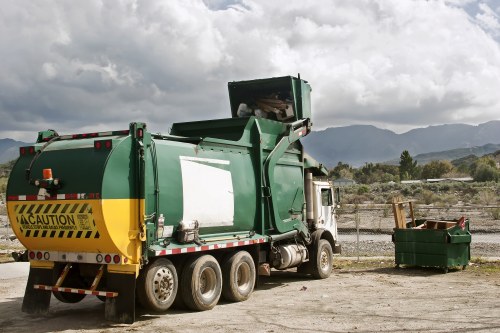
Emergency arrangements are maintained across all clearance sites. Operatives are informed of nearest first aid provisions, assembly points and emergency contacts prior to starting work. A clear procedure exists for managing injuries, significant contamination or structural collapse risks. Where required, specific rescue plans are prepared for working in confined or unstable spaces. Records of incidents, first aid treatment and any follow-up actions are kept to enable learning and corrective action.Safe disposal and environmental considerations form part of our operational duties. Waste segregation is practised to maximise reuse and recycling, minimise landfill and ensure hazardous items are segregated for safe handling. Procedures include safe removal of electronic waste, batteries, chemicals and asbestos-containing materials by authorised handlers. Vehicle movements and loading practices follow safe loading limits and local traffic considerations to protect operatives and the public during collection and transport.
 Continuous monitoring and review are key to improving safety performance in probate clearance operations. Regular site inspections, toolbox talks, audits and staff feedback inform programme improvements. We maintain incident logs and investigate root causes of accidents or near-misses. Lessons learned are translated into updated risk assessments, revised procedures and targeted training to prevent recurrence.
 Training and competence are reinforced by induction sessions, task-specific instruction and refresher training. Topics include manual handling techniques, recognition of asbestos and other hazardous materials, safe use of powered equipment, and personal hygiene when dealing with potentially contaminated environments. Supervisors conduct regular competency checks to ensure that techniques and controls are applied consistently in the field.
 Implementation and review: This policy is implemented through documented procedures, clear responsibilities and ongoing monitoring. Performance indicators and regular reviews ensure the health and safety approach evolves with operational needs and sector best practice. Everyone involved in probate clearance and related estate services is expected to adhere to this policy and to contribute actively to a safe working environment. Strong leadership, clear communication and continuous improvement will remain central to protecting people, property and the environment during every clearance activity.